

What Should You Know Before Buying THC Vapes in the UK?
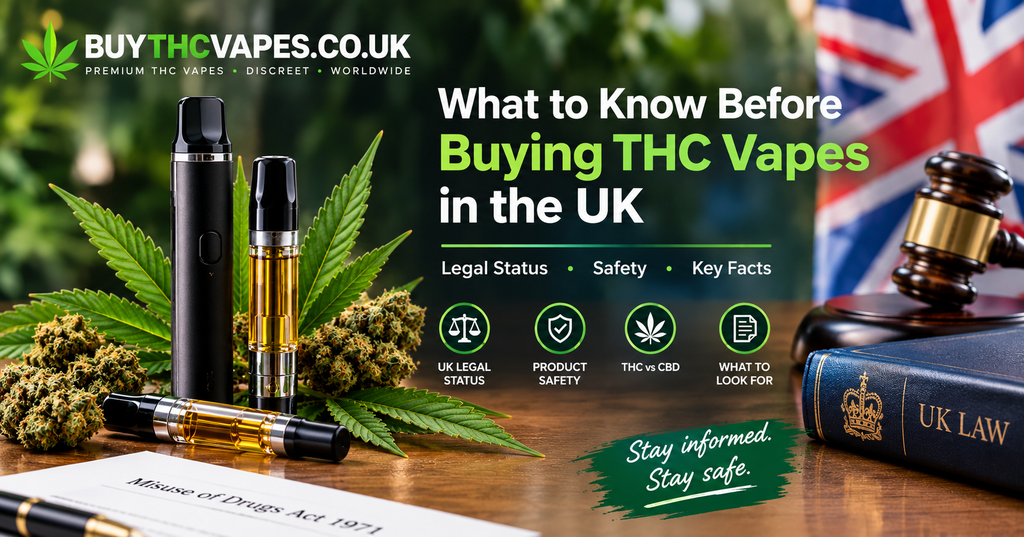
THC, or tetrahydrocannabinol, is the principal intoxicating cannabinoid associated with cannabis. It can affect perception, concentration, coordination, and judgement. In the United Kingdom, THC is generally controlled under drug legislation, and unauthorised possession, supply, production, and importation can have serious legal consequences.
This guide explains what consumers should know about THC vape products, how THC differs from CBD, why online product claims require careful scrutiny, and which UK laws are relevant. It also examines potential health risks, product testing, and the importance of distinguishing prescribed cannabis-based medicines from unregulated consumer products.
Whether you are researching THC vape legality in the UK, trying to understand cannabinoid terminology, or looking for reliable cannabis education, this article provides an overview of the key issues.
Important: This article is for educational purposes only. It does not offer legal advice or recommend purchasing or using unlawful controlled-drug products.
Table of Contents
- What Are THC Vapes?
- What Is THC and How Does It Work?
- What Should You Know Before Considering a THC Vape?
- Are THC Vapes Legal in the UK?
- Can THC Vapes Be Purchased Legally Online?
- THC Vapes vs CBD Vapes: Understanding the Difference
- Understanding THC Vape Ingredients and Labelling
- Product Testing, Authenticity and Contamination Risks
- Potential Health Risks of THC Vapes
- THC Vapes and Driving in the UK
- Medical Cannabis and Prescribed THC Products
- Common Misconceptions About THC Vapes
- Frequently Asked Questions
- Final Thoughts
- Official UK Sources and Further Reading
1. What Are THC Vapes?
Some products advertised online may contain cannabis-derived extracts, while others may contain synthetic or semi-synthetic cannabinoids or substances that are not clearly identified on the packaging. A product’s marketing description alone cannot establish its contents.
How do THC vapes work?
Vaping devices use a heating element to heat a liquid or extract, producing an aerosol that is inhaled. This differs from combustion, which occurs when plant material is burned.
When THC is inhaled, it can enter the bloodstream through the lungs and produce effects relatively quickly. However, the onset, intensity, and duration of effects depend on several factors, including the substance, concentration, device, and individual sensitivity.
Vaping does not eliminate the risks associated with THC. It also introduces separate concerns relating to the inhalation of heated substances, including solvents, additives, contaminants, and potentially harmful by-products.
Why does product composition matter?
Two products carrying similar labels may contain very different ingredients. One might contain a specified cannabinoid, while another could contain undeclared substances or an inaccurately stated concentration.
This is particularly important in an inadequately regulated market, where a professional-looking package or a convincing online description may provide little assurance about the actual contents.
For this reason, it is important to distinguish what a product claims to contain from what can be independently established about its composition and legal status.
2. What Is THC and How Does It Work?
Tetrahydrocannabinol, commonly abbreviated to THC, is a cannabinoid found in cannabis. It interacts with the body’s endocannabinoid system, including CB1 receptors in the brain and nervous system.
These interactions help explain why THC can alter perception, mood, memory, appetite, and motor coordination.
What effects can THC produce?
The effects of THC vary from person to person. They may include:
- Euphoria or changes in mood.
- Altered sensory perception and perception of time.
- Changes in appetite.
- Reduced attention and concentration.
- Impaired short-term memory.
- Slower reaction times and reduced coordination.
- Anxiety, panic, confusion, or paranoia.
- In some circumstances, more serious psychological reactions.
The likelihood and intensity of these effects depend on the amount consumed, the concentration of THC, frequency of use, individual susceptibility, and other substances involved.
A person may not always recognise the extent of their impairment. Feeling relaxed or alert does not necessarily mean that attention, judgement, and reaction time have returned to normal.
Does a higher THC concentration mean a better product?
No. A higher concentration does not automatically indicate better quality, greater safety, or a more suitable product.
Higher THC exposure can increase the likelihood of unwanted psychological and cognitive effects. Product concentration also tells you little about manufacturing quality, the presence of contaminants, or compliance with UK law.
It is therefore misleading to treat potency as the only measure of a product’s quality.
3. What Should You Know Before Considering a THC Vape?
Before evaluating any product advertised as a THC vape, several issues deserve attention. These include its legal status, the accuracy of its ingredient information, the reliability of its manufacturer, and the potential health consequences of inhaling its contents.
Understand the legal position first
In the UK, THC is generally a controlled substance. Products containing controlled THC cannot automatically be treated as ordinary consumer goods, even when they are marketed as premium, hemp-derived, or available for delivery.
The legal position may differ for specific prescribed cannabis-based medicinal products and products that satisfy a relevant statutory exemption. However, these exceptions are limited and do not establish a general right to purchase recreational THC vapes.
Do not rely solely on advertising
Online descriptions may use terms such as “lab-tested”, “pure”, “natural”, “legal THC”, or “premium quality”. These expressions do not independently establish that a product has the claimed composition, is safe to inhale, or can lawfully be sold in the UK.
Consider whether the claims are supported by credible, independently verifiable information. Be especially cautious when a seller does not identify the substances present or makes unrealistic promises about safety and effects.
Recognise the limits of product testing
A laboratory report can provide useful information about the sample tested. However, it does not necessarily prove that every unit from the same seller or batch has the same composition.
Testing also has limitations. A report focused on cannabinoid concentration may not test for every pesticide, residual solvent, heavy metal, microbial contaminant, or unexpected synthetic substance.
Furthermore, laboratory testing cannot, by itself, make a controlled product lawful.
Consider the health implications
Inhaled substances enter the respiratory system, and the long-term effects of many cannabis vape formulations are not well established. Products containing unidentified ingredients or unsuitable additives may pose additional risks.
Anyone who experiences breathing difficulties, chest pain, severe confusion, or other serious symptoms after using a vaping product should seek urgent medical assistance.
Understand the difference between consumer products and medicines
A prescribed cannabis-based medicine is subject to a different regulatory framework from an ordinary vape product sold through an online marketplace.
Medical products may be prescribed in specific circumstances by an appropriately qualified specialist. Their existence does not establish that recreational THC products are lawful or medically equivalent.
4. Are THC Vapes Legal in the UK?
The legal status of THC vapes is one of the most important considerations for anyone researching cannabis products in the United Kingdom.
Under the Misuse of Drugs Act 1971, cannabis is generally classified as a Class B controlled drug. THC and certain other cannabinoids are also controlled under UK drug legislation. The Home Office sets out the relevant rules in its official guidance, Drug licensing factsheet: cannabis, CBD and other cannabinoids.
Official source: https://www.gov.uk/government/publications/cannabis-cbd-and-other-cannabinoids-drug-licensing-factsheet
Is recreational THC legal in the UK?
Recreational THC products are not generally legal in the UK. Unauthorised possession, supply, production, importation, and exportation of controlled cannabis or THC products can constitute criminal offences.
The precise legal position depends on the substance, formulation, and applicable legislation. However, a product does not become lawful simply because it is sold online, shipped from overseas, or advertised as a legal alternative to cannabis.
What does Class B mean?
Class B is a classification under the UK’s Misuse of Drugs Act 1971. Cannabis is generally classified as Class B, although certain medicinal preparations and specific statutory arrangements may be treated differently under the applicable regulations.
The classification is relevant to the potential criminal consequences of unlawful activities involving controlled substances.
It is important not to assume that the classification of a plant automatically answers every legal question about every preparation. Different statutory provisions and exemptions may apply to particular products and circumstances.
Are there exceptions for medical use?
Yes. Certain cannabis-based products for medicinal use in humans can be prescribed under the applicable UK regulations. Specialist doctors may prescribe qualifying products where clinically appropriate.
These arrangements are subject to specific rules and should not be confused with unrestricted recreational sales.
The existence of a lawful medical route does not make all THC oils, cartridges, or disposable vape products lawful for general purchase or use.
What about THC products imported from other countries?
A THC product being available legally in another country does not automatically make it lawful to bring into the UK.
The Home Office explains that controlled-drug importation is subject to UK licensing and exemption requirements. Importing a controlled product without the necessary legal authority can result in serious consequences.
Consumers should not rely on overseas sellers’ claims about legality when determining whether a product can lawfully enter the UK.
Does a “legal THC” label guarantee compliance?
No. A label, website description, certificate, or seller’s assurance does not override UK legislation.
The legal assessment may require consideration of the actual substance, its concentration and formulation, the relevant controlled-drug definitions, and whether a specific exemption applies.
If the legal position of a product is unclear, seek advice from a suitably qualified legal professional rather than relying on the seller’s description.
5. Can THC Vapes Be Purchased Legally Online?
The availability of THC vapes on a website does not establish that the products are lawful to sell or possess.
Online marketplaces may host listings with inaccurate descriptions, unsupported legal claims, or incomplete information about product composition. A seller may also be based in a country whose laws differ from those of the UK.
Why online availability is not proof of legality
There is an important distinction between a product being advertised and its lawful supply.
A website listing does not demonstrate that the seller has the necessary authorisations, that the product satisfies UK controlled-drug legislation, or that the product has been manufactured to an appropriate standard.
Similarly, accepting online payments, offering delivery, or displaying customer reviews does not establish legal compliance.
What about discreet packaging and delivery claims?
Packaging and delivery arrangements do not determine the legal status of a controlled substance.
Descriptions such as “discreet shipping”, “secure delivery”, or “international dispatch” should not be interpreted as evidence that a product can lawfully be supplied or imported.
For businesses operating in this area, it is important to obtain appropriate legal and regulatory advice before advertising, listing, supplying, or importing products that may contain controlled cannabinoids.
Why accurate information matters
Consumers benefit from clear information that distinguishes lawful medicinal products, non-controlled substances, and products that may fall under controlled-drug legislation.
Websites publishing information about THC vapes should avoid presenting unverified legal claims as facts. Clear, accurate educational content helps readers understand the limitations of online product descriptions and the importance of checking official sources.
6. THC Vapes vs CBD Vapes: Understanding the Difference
THC and CBD are both cannabinoids associated with cannabis, but they have different pharmacological effects and different legal considerations.
THC is the principal cannabinoid associated with the intoxicating cannabis high. CBD, or cannabidiol, does not typically produce the same intoxicating effect.
However, neither the product name nor the presence of CBD alone determines whether a finished product is lawful.
| Feature | THC vape | CBD vape |
|---|---|---|
| Main substance | THC or a product advertised as THC-containing | CBD or a product advertised as CBD-containing |
| Typical intoxicating effect | THC can cause a high | CBD does not typically cause a THC-like high |
| UK controlled-drug considerations | THC is generally controlled | Pure CBD is not controlled in itself, but product composition matters |
| Health considerations | Intoxication, impaired coordination, anxiety, and inhalation-related risks | Possible drowsiness, interactions, and inhalation-related risks |
| Product quality | Composition and contaminants may be uncertain | Composition and contaminants may also be uncertain |
| Legal conclusion | Recreational THC products are not generally lawful | Legality depends on ingredients, intended use, and applicable regulations |
Is CBD automatically legal because it is non-intoxicating?
No. Pure CBD is not controlled under the Misuse of Drugs Act 1971 in itself, but the Home Office explains that CBD products may contain controlled cannabinoids, including THC.
The finished product must therefore be considered separately from the isolated substance.
CBD products may also be subject to requirements under food, medicines, cosmetics, and general product-safety legislation, depending on their intended use and formulation.
Are CBD and THC interchangeable?
No. They have different effects and should not be treated as equivalent substances.
CBD should not be assumed to neutralise THC’s intoxicating effects or make a THC-containing product lawful. Likewise, evidence relating to a specific CBD medicine cannot automatically be applied to an unverified THC or CBD vape.
Understanding these differences is essential when reading product labels, health claims, and information about UK cannabinoid regulation.
7. Understanding THC Vape Ingredients and Labelling
Product labels can provide useful information, but they should not be treated as conclusive proof of a product’s contents or legal status.
Cannabinoid names and concentrations
A product description may list THC, CBD, or another cannabinoid. However, the presence of a name on a label does not prove that the ingredient is present in the stated amount.
Some products may use vague terminology or fail to identify all their ingredients. Other products may contain cannabinoid-related substances that have different effects and regulatory implications.
Carrier liquids and additives
Vaping formulations may contain solvents, carrier liquids, flavourings, or other additives. The safety of an ingredient depends partly on the substance itself, its concentration, and whether it is suitable for inhalation under the conditions in which it is heated.
An ingredient considered suitable for one use is not automatically suitable for inhalation. Heating can also change the chemical composition of some substances and produce potentially harmful by-products.
Synthetic and semi-synthetic cannabinoids
Not every product advertised using cannabis terminology necessarily contains only naturally occurring cannabinoids.
Some products may contain synthetic or semi-synthetic substances designed to produce cannabis-like effects. Their potency, effects, and risks may differ from those of THC, and their legal classification must be assessed individually.
Unclear ingredient lists are therefore an important reason for caution.
Why transparent labelling matters
Clear product information can help identify ingredients, manufacturer details, batch information, and relevant safety warnings.
Nevertheless, good presentation and detailed packaging do not independently establish that a product is safe, correctly formulated, or lawful. Those questions require appropriate evidence and a product-specific regulatory assessment.
8. Product Testing, Authenticity and Contamination Risks
Product testing is frequently mentioned in discussions of THC vapes, but the meaning and limitations of testing are important.
What can laboratory testing establish?
Depending on the laboratory and test panel, analysis may identify certain cannabinoids, estimate their concentrations, and detect specified contaminants.
A useful report should identify the tested sample and make clear which substances were included in the analysis. It should also provide enough information to determine whether the report is relevant to the product being assessed.
What are the limitations?
A report does not necessarily cover every possible contaminant or unexpected ingredient. For example, a cannabinoid profile alone may not provide information about all residual solvents, pesticides, heavy metals, or microbial hazards.
A report for one sample also cannot automatically guarantee the quality of every other unit sold under the same brand.
In addition, laboratory results do not establish that a product complies with every applicable legal requirement.
What does authenticity mean?
Authenticity involves more than matching a logo or package design. Counterfeit packaging may imitate established brands, while a product with genuine packaging can still have uncertain contents or inappropriate quality controls.
Consumers should not treat visual similarity, brand claims, or seller assurances as conclusive evidence of authenticity.
Why this matters for public safety
Uncertain composition can make it difficult to anticipate the effects of inhalation. Unexpected ingredients may create additional health risks, particularly when their identity or suitability for vaping is unknown.
This is one reason why reliable product information, independent testing, and regulatory oversight are important topics in cannabis education.
9. Potential Health Risks of THC Vapes
THC vapes can present risks associated with both THC exposure and inhaling substances produced by a vaping device.
The extent of risk varies with the formulation, amount of THC, frequency of exposure, individual health, and the presence of other ingredients.
Cognitive and psychological effects
THC can affect memory, attention, coordination, and judgement. It can also cause anxiety, panic, confusion, or paranoia.
Some individuals may be more vulnerable to serious psychological effects, particularly with frequent use, higher THC exposure, or an existing susceptibility to certain mental health conditions.
Respiratory concerns
Vaping exposes the lungs to an aerosol containing substances from the heated formulation. The risks depend on what is in the product and how it behaves when heated.
Poorly characterised products may contain contaminants or additives that have not been adequately assessed for inhalation. The long-term effects of many THC vape formulations remain uncertain.
Dependence and frequent use
Frequent cannabis use can lead to cannabis use disorder in some individuals. Warning signs may include difficulty controlling use, continued use despite negative consequences, or finding it difficult to reduce consumption.
If cannabis use begins affecting relationships, education, work, finances, or wellbeing, it may be helpful to seek confidential support from a healthcare professional or drug-support service.
When to seek medical help
Serious symptoms following vaping should not be ignored. Severe breathing difficulties, chest pain, collapse, seizures, or extreme confusion require urgent medical attention.
In an emergency in the UK, call 999. For non-emergency health concerns, contact NHS 111 or a healthcare professional as appropriate.
10. THC Vapes and Driving in the UK
Driving after consuming THC is a serious safety concern because THC can impair attention, judgement, coordination, and reaction time.
In England, Wales, and Scotland, specific drug-driving offences include driving with certain controlled drugs above specified limits in the blood, subject to the applicable statutory provisions and medical-defence rules.
Northern Ireland has its own road-traffic legislation, so the exact legal provisions differ across the UK.
Why impairment matters
A person may underestimate their impairment, particularly if they are familiar with cannabis or believe that the effects have worn off.
Reaction time, divided attention, and the ability to respond to unexpected hazards may remain affected. There is no single time interval that can guarantee every individual is fit to drive after THC exposure.
Prescription medicines and driving
Some prescribed medicines can affect driving ability. The existence of a prescription does not mean a person can safely drive while impaired, and the applicable legal provisions must be considered.
Anyone using a prescribed cannabis-based medicine should follow their clinician’s instructions and official driving guidance. If they feel impaired, they should not drive.
For general information, consult the relevant official UK government guidance on drug driving and seek professional advice where necessary.
11. Medical Cannabis and Prescribed THC Products
Medical cannabis is an important part of the discussion about THC, but it must be distinguished from recreational cannabis products.
In the UK, certain cannabis-based products for medicinal use can be prescribed by specialist doctors under specific regulatory arrangements. Whether a product is suitable for a patient depends on the clinical circumstances, the product involved, and the applicable prescribing requirements.
How are prescribed cannabis-based medicines different?
Prescribed medicines are subject to clinical and regulatory considerations that do not automatically apply to ordinary consumer products.
These may include:
- Assessment by an appropriately qualified medical professional.
- Consideration of the patient’s medical history and other medicines.
- Selection of a suitable medicinal product.
- Instructions about administration and monitoring.
- Consideration of potential adverse effects and interactions.
The fact that a medicinal product contains THC does not mean that an unregulated product with a similar label has equivalent quality, safety, or effectiveness.
Can anyone obtain a prescription for THC?
No. A prescription is not an automatic entitlement. Specialist doctors consider whether treatment is clinically appropriate, and the applicable rules determine which products may be prescribed.
People seeking information about cannabis-based treatment should speak to a qualified healthcare professional.
The official GOV.UK resource on medicinal cannabis information and resources provides further information about the UK framework.
12. Common Misconceptions About THC Vapes
Misleading claims can make it difficult to distinguish reliable information from marketing. The following misconceptions are particularly important.
Myth 1: If a THC vape is sold online, it must be legal
Fact: Online availability does not establish legal compliance. A product may be advertised even when its supply, possession, or importation is unlawful.
Myth 2: A product labelled “hemp-derived” is automatically legal
Fact: The source of an ingredient does not, by itself, determine the legal status of the finished product. The substance, formulation, and relevant legislation must be considered.
Myth 3: A laboratory report guarantees that a product is safe
Fact: Testing can provide useful information, but its value depends on the sample, laboratory methods, and substances tested. A report cannot guarantee that every risk has been excluded.
Myth 4: CBD and THC have the same effects
Fact: THC is intoxicating, whereas CBD does not typically produce the same high. They have different pharmacological profiles and should not be treated as interchangeable.
Myth 5: A high THC concentration means better quality
Fact: Potency does not establish product quality or safety. A highly concentrated product may increase the risk of unwanted effects, and concentration figures do not establish manufacturing standards.
Myth 6: Medical cannabis rules make recreational THC vapes legal
Fact: Prescribed cannabis-based medicines operate under a specific legal framework. This does not create general permission to sell or possess recreational THC products.
Myth 7: “THC-free” on the packaging is conclusive proof
Fact: A marketing statement is not the same as verified composition. Product claims must be assessed alongside reliable evidence and the applicable law.
13. Frequently Asked Questions About THC Vapes in the UK
Are THC vapes legal in the UK in 2026?
Recreational THC vapes containing controlled THC are not generally lawful consumer products in the UK. Specific prescribed medicinal products and applicable statutory exemptions are treated separately. The exact position depends on the substance and circumstances.
Can I buy THC vape cartridges legally in the UK?
You should not assume that an online THC cartridge listing represents a lawful sale. Products containing controlled THC are subject to UK drug legislation, and lawful medicinal arrangements do not create a general right to purchase recreational cartridges.
Is THC a Class B drug?
THC is generally controlled as a Class B drug under the Misuse of Drugs Act 1971 and associated legislation. The precise legal classification of a preparation may depend on its composition and the applicable provisions.
What is the difference between THC and CBD vapes?
THC is associated with intoxicating effects, including altered perception and impaired coordination. CBD does not typically cause the same high. However, the ingredients, safety, and legal status of each finished vape product must be considered separately.
Are hemp-derived THC vapes legal?
The description “hemp-derived” does not automatically make a THC product lawful in the UK. Controlled-drug legislation may still apply, depending on the substance and formulation.
Can I import THC vapes from another country?
A product’s legality in another country does not establish that it can lawfully be imported into the UK. Controlled-drug importation may require the appropriate authorisation unless a relevant exemption applies.
Are CBD vapes automatically legal?
No. Pure CBD is not controlled in itself under the Misuse of Drugs Act 1971, but a finished CBD product may contain controlled cannabinoids or fall under other regulatory requirements. The exact product must be assessed.
Can THC vapes cause side effects?
Yes. THC can affect memory, concentration, coordination, and mood. It may also cause anxiety or paranoia. Inhaling aerosols from products with uncertain ingredients introduces additional respiratory concerns.
Are THC vapes safer than smoking cannabis?
It is not possible to make a blanket claim that THC vaping is safe or safer in every circumstance. Vaping avoids combustion, but it can expose users to other potentially harmful substances. Risks depend on the product, its formulation, and the pattern of use.
Can THC vapes affect driving?
Yes. THC can impair attention, coordination, judgement, and reaction time. UK drug-driving legislation also includes offences relating to specified controlled drugs in blood. Anyone who feels impaired should not drive.
Is prescribed medical cannabis the same as a recreational THC vape?
No. Prescribed cannabis-based medicines are subject to specific clinical and regulatory arrangements. An ordinary consumer vape is not equivalent to a prescribed medicine merely because both may contain THC.
Where can I find reliable information about THC laws?
The Home Office’s official guidance on cannabis, CBD, and other cannabinoids is a useful starting point. The legislation itself and relevant NHS or government resources can provide additional information about controlled drugs, medical treatment, and health risks.
14. Final Thoughts: What Should You Know Before Buying THC Vapes in the UK?
Understanding THC vape products involves more than comparing brands, concentrations, or online descriptions. The most important considerations are the product’s legal status, the accuracy of its ingredient information, its potential health risks, and the reliability of any claims made about it.
THC is generally controlled under UK drug legislation, and recreational THC vapes are not generally lawful consumer products. Specific arrangements exist for qualifying prescribed cannabis-based medicines, but these must not be confused with ordinary products advertised online.
Consumers should be wary of unsupported claims that a product is legal, safe, pure, or guaranteed to produce a particular effect. Laboratory testing can provide useful evidence, but it does not independently establish legality or eliminate every health risk.
For businesses publishing information about cannabis-derived products, accuracy and transparency are equally important. Educational content should explain the difference between THC and CBD, recognise the limits of available evidence, and direct readers to official sources when discussing legislation.
Ultimately, informed decisions begin with understanding the ingredients, the risks, and the law. Taking time to verify reliable information is more valuable than relying on marketing claims or assumptions about what is permitted in the UK.
Disclaimer
This article provides general educational information and does not constitute legal or medical advice. It does not recommend purchasing or using unlawful controlled-drug products. UK legislation and regulatory requirements may change, and the legal position can depend on the precise substance, formulation, intended use, and circumstances. Consult official guidance or a suitably qualified professional about a specific situation.
15. Official UK Sources and Further Reading
For additional information, consult these authoritative sources:
- Home Office — Drug licensing factsheet: cannabis, CBD and other cannabinoids
https://www.gov.uk/government/publications/cannabis-cbd-and-other-cannabinoids-drug-licensing-factsheet - GOV.UK — Medicinal cannabis information and resources
https://www.gov.uk/government/collections/medicinal-cannabis-information-and-resources - Legislation.gov.uk — Misuse of Drugs Act 1971
https://www.legislation.gov.uk/ukpga/1971/38/contents - NHS — Medical cannabis and cannabis oils
https://www.nhs.uk/medicines/medical-cannabis/
These sources should be checked periodically to ensure that information about controlled drugs, medicinal products, and UK regulations remains accurate.